
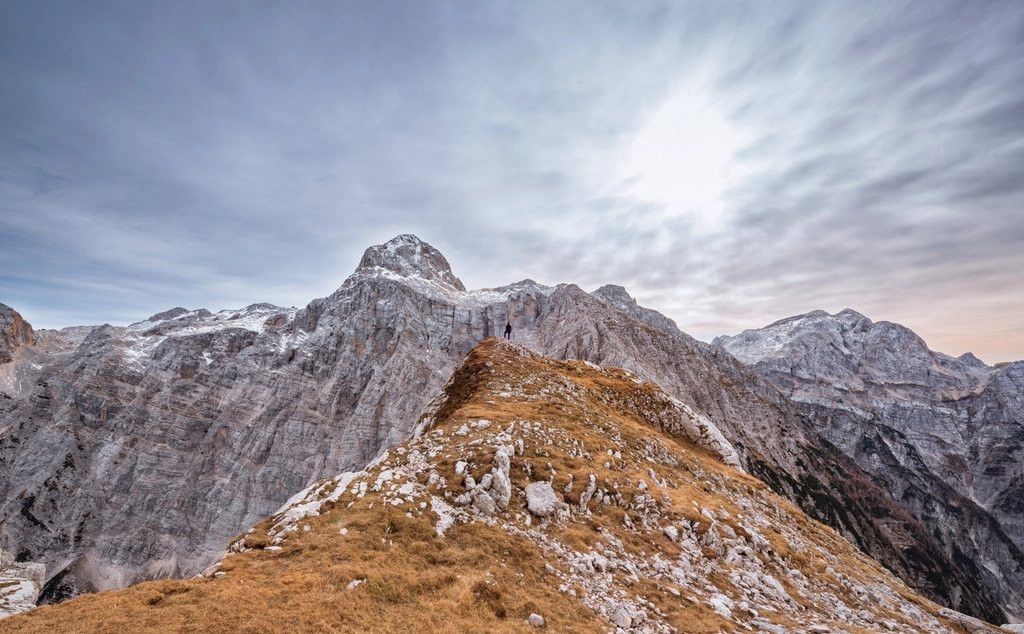
Every Slovene, the saying goes, should stand on Triglav at least once. At 2,864 m it is the highest point in the Julian Alps and the emblem on the national flag, and on a fine July weekend its summit ridge can feel like a village square. Yet the mountain is also a serious limestone peak with two long approaches from the north, both of which finish on the same secured ridge above the hut plateau at Kredarica. The choice between the Krma and the Vrata valleys shapes the whole two-day trip: how much cable you want under your hands, how early you have to start, and where you sleep.
Two valleys, one summit
The Krma and the Vrata are neighbouring glacial valleys cutting south into the Triglav massif from the Sava Dolinka side, near Mojstrana. The Vrata is the dramatic one: it ends beneath the north face of Triglav, a wall roughly 1,000 m high and 3 km wide that is one of the great faces of the Alps. The Krma is the quiet one, a broad, wooded trough that climbs steadily toward the high karst plateau. Both valleys deliver you to the hut at Kredarica, at 2,515 m, or to its neighbour on the Planika meadow at 2,401 m, from which the summit is a further 350 to 460 m of secured ridge.
The whole massif lies inside Triglav National Park, Slovenia’s only national park, and the usual rules apply in general terms: stay on marked paths, no wild camping, and carry out everything you carry in. Paths are waymarked with the red circle and white centre that Slovenian hikers know by heart.
The Krma valley: the long, gentle way
The Krma route starts at the road end near 950 m, and the trailhead hut sits a little further up at the foot of the valley. From there the path climbs some 1,550 m to Kredarica, most of it on a broad mule track that switchbacks through beech and larch before breaking out onto the limestone pavements above the tree line. There is no cable and no exposed step on the entire route, which is why it is the standard descent for people who have come up something harder, and the standard ascent for families, for winter ski tourers and for anyone who does not enjoy vertical rock.
Allow five to six hours to the hut with a normal pack. The middle section, across the karst above the Konjsko saddle, is featureless in cloud and the marks matter; in good weather the reward is a slow reveal of the summit pyramid over the rim of the plateau. Water is scarce once you leave the valley floor, so carry at least two litres from the last spring.
The Vrata valley: cables, ledges and the north face
The Vrata approach begins at the hut at the valley head, at 1,015 m, where the road from Mojstrana ends after about 12 km. From the car park you already have the north face filling the sky. Two marked routes leave from here toward Kredarica, and both are graded as secured paths in Slovenian terms, meaning steel cables, pegs and short ladders on the steep sections. The Tominsek route climbs the flank directly above the hut and is the more sustained of the two; the Prag route crosses the foot of the face before tackling a steep rock step, the Prag itself, where the cables come thick and fast.
Either way the ascent to Kredarica is around 1,500 m and takes five to six hours. A helmet is sensible: the routes are popular and stonefall from parties above is the real hazard, more than the exposure. A sound plan is the Vrata for the ascent and the Krma for the descent, so that the steep ground is taken uphill with fresh legs and the knees are spared on the way down.
Hut life on the plateau
The hut at Kredarica is the highest staffed hut in Slovenia and shares its perch with a mountain weather station, which is why a caretaker presence continues through the winter in a reduced form. In summer it sleeps around 300 people in dormitories and small rooms, and on peak weekends every one of those places goes. Reservations are expected in high season, and a booking for the plateau huts is the one part of a Triglav trip that should never be left to chance. Half board is the sensible option: a plate of hot food after 1,500 m of ascent, breakfast before the ridge, and a packed lunch if you ask the night before.
The hut on the Planika meadow, a little lower and a little quieter, is the alternative, and the third hut of the plateau lies at 2,332 m on the Krma side. Between them they give the massif an unusual flexibility: you can climb the mountain from one and descend to another without ever retracing your steps. The summer season on the plateau runs, in general terms, from the second half of June to the end of September, with the huts closing as soon as the first serious snow arrives.
The summit ridge
From Kredarica the path drops briefly and then climbs Mali Triglav, the “little” Triglav at 2,725 m, on a series of secured rock steps. What follows is the reason the mountain is respected: a narrow ridge, cabled throughout, with drops on both sides and a steady stream of people going in both directions. It is not technically difficult, but it demands care and, on a busy day, patience. Allow ninety minutes to two hours from the hut to the summit, and nearly as long back down.
On the summit stands the small metal shelter erected in 1895, a cylindrical tower barely tall enough to stand up in, which has become the most photographed object in Slovenia’s mountains. First-time summiteers are, by tradition, “baptised” with a light whack from a rope or a birch switch, and the tradition is enthusiastically kept. On a clear morning the view runs from the Adriatic to the Austrian Tauern and across the whole Julian chain.
Practical notes for a two-day traverse
- Day 1: Vrata to Kredarica by the Tominsek or Prag route, 1,500 m of ascent, 5 to 6 hours.
- Day 2: summit ridge at dawn, back to the hut for a second breakfast, then descend the Krma to the road end, 1,550 m of descent, 4 to 5 hours.
- Logistics: the two trailheads are about 20 km apart by road, so a shuttle, a taxi or a friend with a car is needed.
- Kit: helmet, gloves for the cables, a via ferrata set if you want the extra security on the ridge, and warm layers at any time of year.
Whichever valley you choose, start early. Afternoon storms build over the Julian Alps with real speed in summer, and the summit ridge, with all that steel, is nowhere to be when they arrive. The mountain will still be there in the morning; so, with luck, will you.