
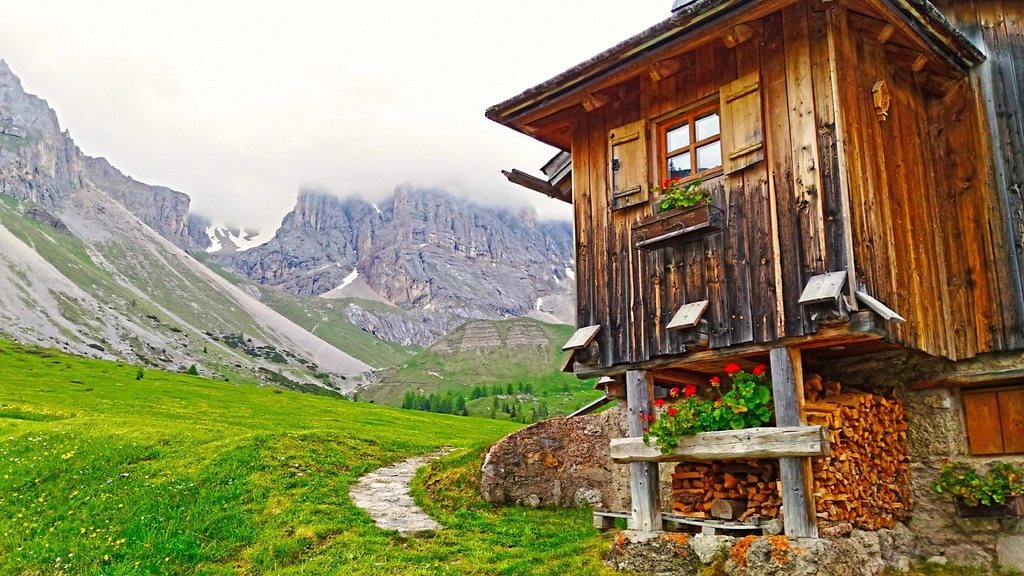
First-time visitors to a mountain hut tend to get several things wrong. They keep their boots on past the door, ask for a room, and have no idea what the small slip of paper pinned to the bunk is for. Nobody minds much, but it takes a few evenings to understand that a hut is not a hotel with a view. It is a shared house run on a rhythm, and once you know the rhythm, everything about hut-to-hut hiking in the Alps becomes simpler and more pleasant.
What a hut actually is
Most huts on the classic Alpine routes belong to national alpine clubs and are run by a warden, often a family, under contract for the summer season. A few are private, and the rules vary slightly, but the model is the same across the Dolomites, the Swiss and French Alps, Slovenia and the Tatras. You sleep in a dormitory or, increasingly, a small room with four to eight beds. You eat what is served. You pay for a bed and for meals, and in most places you also pay a little for a hot shower, if there is one at all.
Huts sit anywhere from about 1,500 m to over 3,000 m. Below the tree line they may have a road or a cable car nearby and feel almost like inns. Higher up, everything comes in by helicopter or on the back of the warden, and the prices, the water and the menu reflect that.
Half board and how meals work
The standard arrangement is half board, sometimes written as HB or demi-pension: a bed, dinner and breakfast. Dinner is served at a fixed time, usually between 18:00 and 19:00, and it is nearly always a set menu of three or four courses. Soup, a main dish with pasta, polenta, rice or potatoes, a salad or vegetables, and a small dessert. In the Dolomites you will see more dumplings and polenta; in the French Alps more gratins and lentils; in Slovenia a thick soup and a stew. Vegetarian options exist almost everywhere if you ask when you book or when you arrive, and vegan or allergy-specific meals are possible in the bigger huts if you give notice.
Breakfast is simple: bread, butter, jam, cheese, sometimes an egg or muesli, tea and coffee. It is served early, from about 06:00 to 07:30, because everyone needs to be walking before the afternoon storms. Most huts will also make you a packed lunch if you ask the evening before, usually a sandwich, a piece of fruit and a bar.
Members of an alpine club that has reciprocal agreements pay a reduced rate for the bed, sometimes half the non-member price. If you are planning more than four or five hut nights in a season, membership in one of the clubs usually pays for itself. Meals cost the same for everyone.
Booking a bed
Twenty years ago you could turn up and hope. On the famous routes, the Alta Via 1 in the Dolomites, the Tour du Mont Blanc, the Haute Route from Chamonix to Zermatt, that is no longer realistic in July and August. Most huts now take reservations through an online system run by the alpine clubs or by the hut itself, and the popular ones fill months ahead. Reservation windows typically open in the winter or early spring for the following summer. In the shoulder seasons, mid June and September, there is still room to be flexible, and many huts hold a few beds for walkers who arrive on foot without a booking, though you cannot rely on it.
Two rules of hut etiquette matter more than any other. First, if you have booked and cannot come, cancel. A hut that expects you will keep a bed empty and cook a dinner for nobody, and on a stormy evening they may even start worrying about you. Second, if you are running late, call. Wardens keep an eye on who has not arrived by dinner time.
When you arrive, you will check in with the warden, give your name and your next destination, and often be shown a bunk number on a list. Some huts ask you to pay on arrival, some on departure. Many small huts accept only cash, so carry enough for two or three nights even if the last hut took a card.
Hut shoes and the boot room
Every hut has a boot room, or at least a rack by the door, and every hut expects you to leave your boots there. Inside you wear hut shoes: rubber clogs or slippers that the hut provides in a jumble of sizes by the entrance. Some walkers carry their own lightweight sandals or foam clogs, which is a good idea if you have large feet or simply prefer your own. Poles, ice axes and crampons stay in the boot room too, and a drying room with a heater is usually available for wet gear.
The Huttenschlafsack
The one item you will be asked about is the sleeping bag liner, in German the Huttenschlafsack. Huts provide mattresses, pillows and blankets or duvets, but they do not wash the bedding after every guest, so a liner is required in nearly all club huts and expected in the private ones. It is a thin sleeping bag made of cotton, silk or synthetic fabric that goes between you and the blanket. Silk is the lightest, about 100 g, and packs to the size of a fist. Cotton is cheaper and heavier, closer to 300 g.
You do not need a real sleeping bag. Huts are heated, or at least insulated, and the blankets are warm. The only exception is an unstaffed winter room or bivouac shelter, where you should carry a proper bag.
A typical evening and morning
- Arrive between 15:00 and 17:00, before the weather turns. Boots off, hut shoes on, check in.
- Claim a bunk, lay out your liner, hang wet clothes in the drying room.
- Dinner at a fixed time, shared tables, a chance to ask about tomorrow’s route.
- Lights out and quiet hours around 22:00; earplugs are the best 5 g you will carry.
- Breakfast from 06:00, settle the bill, fill water bottles, and be walking by 07:30.
That is really all there is to it. The hut system in the Alps has run this way for well over a century, and it works because everyone follows the same simple habits. Book, cancel if you must, take your boots off, bring a liner, and sit down to dinner on time. After the second or third night you will stop thinking about the rules at all, and start noticing the things that matter: the light on the ridge, the soup, and the sound of rain on a roof you are very glad to be under.