
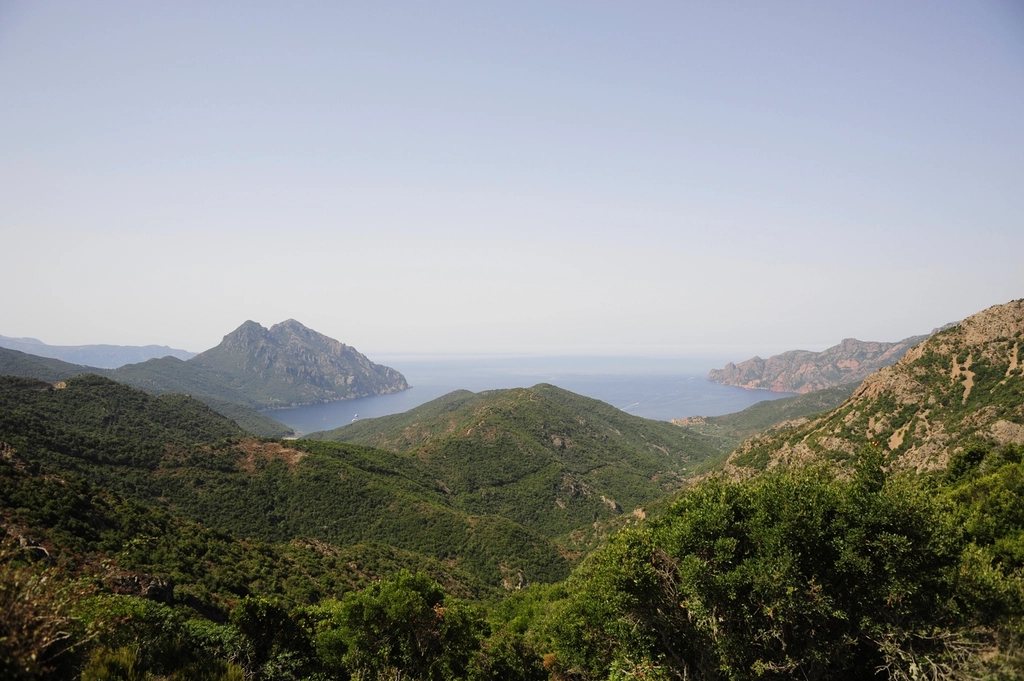
Ask anyone who has finished the GR20 what they remember first and they rarely mention the views. They talk about the first hour out of Calenzana, the chain sections above the Asco valley, the day the water ran out on the way to Vizzavona. Corsica’s long-distance trail is not the longest walk in Europe, nor the highest, but it is the one that feels most like mountaineering with a rucksack. About 180 km of red and white paint marks lead from Calenzana in the north-west to Conca in the south-east, along the granite spine that splits the island in two. Sixteen stages is the traditional count, and the cumulative ascent over those stages is close to 10,000 m.
Why the GR20 earns its reputation
The difficulty is not altitude. The highest point on the standard route, the Pointe des Eboulis, sits at 2,607 m, and most of the trail runs between 1,200 m and 2,300 m. What wears you down is the ground itself. The northern half is almost entirely rock: slabs, boulder fields, short scrambles secured with chains, and gullies where the paint marks lead straight up a stream bed. A 10 km stage can take eight hours. Add a Mediterranean sun that hits hard by nine in the morning and the thin shade of laricio pines only in the valleys, and the GR20 becomes an exercise in pacing. The southern half is gentler, greener and faster, but it comes after the north has already emptied your legs.
The trail was created in 1972 and the route has changed only once in a significant way. After a fatal rockfall in 2015 the descent through the Cirque de la Solitude was closed, and the stage from Ascu Stagnu now climbs over the shoulder of Monte Cinto instead. It is longer and higher, and on a clear morning it is arguably the finest day of the whole walk.
The northern half: Calenzana to Vizzavona
Calenzana sits at about 275 m among olive groves a few kilometres inland from Calvi. The first stage climbs more than 1,300 m to the refuge at Ortu di u Piobbu and sets the tone: steep, hot and rocky. The next days pass the refuges of Carrozzu and Ascu Stagnu, then the big traverse to Tighjettu below Monte Cinto, the island’s highest summit at 2,706 m. Monte Cinto itself is a detour from the pass, feasible in fine weather for anyone comfortable on loose rock. From Tighjettu the trail drops to the Col de Vergio, crosses the open grassland around Lac de Ninu at 1,743 m, and continues by the Manganu and Petra Piana refuges to the crest above the Restonica valley. The descent to Vizzavona, through beech woods beside the Agnone waterfalls, is a relief for the knees. Vizzavona has a railway station, which makes it the natural place to split the trail into two halves, or to leave with dignity if the body has had enough.
The southern half: Vizzavona to Conca
South of Vizzavona the granite softens into rolling ridges and the walking changes character. The stage over Monte d’Oro’s flank to the refuge at Capannelle is long but rarely technical. Then comes the crossing of the Bocca di Verdi and the climb to Prati, and the famous ridge walk above the Plateau du Cuscionu, where wild pigs and semi-feral horses graze at 1,500 m. Monte Incudine, at 2,134 m, is the last summit on the route and one of the few that the trail actually crosses. The descent into the Bavella needles is the visual climax: red towers, pale slabs and the sea suddenly visible to the east. From the Col de Bavella the final two stages, by the refuge of Paliri, drop through maquis and holm oak to Conca at 252 m.
Hut life on the GR20
The refuges along the trail are run by the regional natural park and follow a pattern quite different from the Alps. Each hut has a small dormitory, a kitchen area with gas rings that walkers may use, a warden in summer, and above all a camping area where most people actually sleep. In season the huts hire tents already pitched on wooden platforms, which is a common compromise: no dormitory snoring, no need to carry a tent up 1,300 m of rock. Bunk places are limited and are booked through the park’s online system; tent pitches and hired tents are booked the same way. Whichever you choose, book early, because the trail has become popular and July and August fill months ahead.
Food is the other surprise. Most huts sell basic supplies, cold drinks and, in the evening, a simple hot meal, but there is no formal half board in the Alpine sense. Bergeries, the summer sheep farms scattered along the route, sell cheese, charcuterie and sometimes a full dinner. Carry two or three days of food at a time and refill where you can. Water is the critical resource: every refuge has a source, but stretches between them can be dry by August.
When to go and how long to allow
The huts are staffed from roughly late May or early June to the end of September, and that is the window for a walker without winter equipment. In June the high passes may still hold snow patches, streams are full and the days are long. July and August are the busiest and hottest months, with real risk from heat and afternoon storms. September is often the best month: cooler, quieter, and the sea still warm enough to swim in at the end. Sixteen days is the classic schedule; fit walkers often manage it in twelve to fourteen by combining stages. A rest day at Vizzavona is worth building in.
What to carry and what to expect
Pack light, then remove something. Everything you carry has to go up and down granite steps for two weeks, and the difference between a 9 kg and a 13 kg rucksack is the difference between enjoying the Bavella ridge and enduring it. The essentials are simple:
- Boots or approach shoes with sticky soles and a stiff enough midsole for slabs and loose rock.
- A sleeping bag rated to around 5 C, even in August, because huts sit at 1,500 to 2,000 m and hired tents are not warm.
- At least 2.5 litres of water capacity and the discipline to fill up at every source.
- Sun protection that assumes eight hours of exposure a day, plus a light waterproof for the storms.
- Cash for the bergeries and the smaller huts, where cards may not be accepted.
The GR20 rewards respect more than strength. Start early every day, eat before you are hungry, and treat every chain section as a place to slow down. If you finish at Conca with sore feet and a wide grin, you will have joined a small and slightly obsessive club. Most of its members are already planning to go back.