
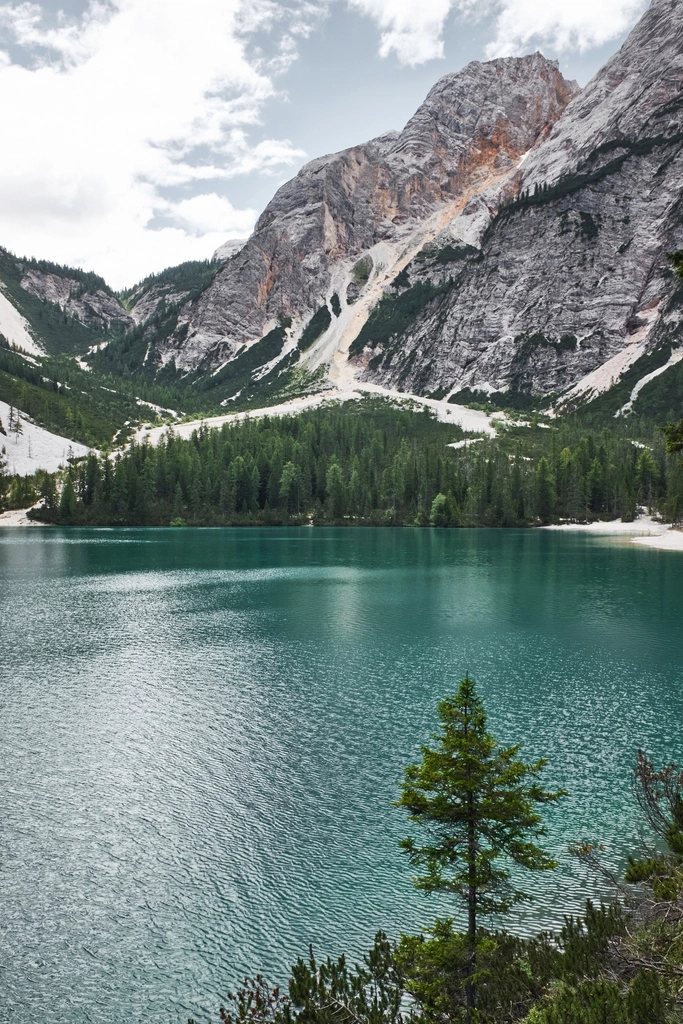
The Alta Via 1 is the walk most people do first in the Dolomites, and one that many walkers return to. It runs roughly 120 km from north to south, from the milky green water of Lago di Braies at 1,496 m to the outskirts of Belluno, and it takes most walkers eight to twelve days. It is not a technical route. There are no glaciers, the waymarking is excellent, and the few exposed passages have cables or can be avoided. What it asks for instead is stamina, a light pack and a taste for the particular rhythm of the huts: an early start, a long climb, a pass, a descent to a table with a bowl of barley soup, and an evening watching the pale rock turn pink.
The shape of the route
The Alta Via 1 crosses the Dolomites along their eastern edge, threading between the great massifs rather than over them. From Braies the path climbs to the high plateau of Sennes and Fanes, where the huts sit at around 2,000 to 2,300 m in wide grassy basins that feel more like the Scottish Highlands than the Alps. Then the tone changes. The route rises to the Lagazuoi, at 2,752 m the highest point of the whole traverse, drops past the Cinque Torri and the Nuvolau, crosses the Passo Giau and follows the long flank of the Pelmo and the Civetta. The final days, south of the Passo Duran, are quieter and wilder: the Schiara and the Pramper valleys see a fraction of the traffic of the northern half, and the last hut before Belluno is often half empty even in August.
Total ascent over the full route is a little under 7,000 m, with a similar amount of descent. Individual stages typically run 5 to 7 hours, though the stage from the Lagazuoi to the Nuvolau can be stretched or shortened depending on how the huts are booked, and the section around the Civetta is easily split in two.
Braies to the Fanes plateau
The first morning starts gently along the lake, then climbs hard. Around 900 m of ascent lead to the Forcella Sora Forno at 2,388 m and the hut on the Sennes plateau at 2,327 m, and most of that height is gained in the first three hours. It is a rough introduction, but the reward is immediate: the Croda del Becco leans over the lake behind the walker, and ahead lies a rolling limestone tableland dotted with cattle and karst hollows.
The next day is a pleasure. The path drops through larch forest to the Pederu valley, climb again to the Fanes basin at about 2,060 m and walk alongside small lakes toward the huts at the head of the valley. The altitude is modest, the distances are short, and this is where the Alta Via feels most like a holiday. Many walkers spend two nights here on purpose, and the crossing of the Forcella del Lago at 2,486 m on the following stage, with its steep scree descent to the Lago di Lagazuoi, is one of the finest half days of the route.
The Lagazuoi and the war
The climb to the hut below the Lagazuoi summit is short but sharp, and the view from the terrace, across to the Tofane, the Marmolada and the Sella, explains the crowds. This is also where the First World War is impossible to ignore. Between 1915 and 1917 the Austrian and Italian front lines ran along these ridges, and the mountain is honeycombed with tunnels blasted by both sides. The descent through the Lagazuoi galleries, a series of tunnels dropping more than 500 m inside the rock to the Passo Falzarego, is optional but unforgettable. Bring a headtorch and expect it to be cold and wet even in July.
From the pass the route continues to the Cinque Torri, the five limestone towers loved by climbers, and to the small hut on the Nuvolau at 2,575 m. This is arguably the best-placed hut in the Dolomites, on a summit with a 360-degree view, and it is often booked out weeks ahead in high season.
Pelmo, Civetta and the long southern days
South of the Passo Giau at 2,236 m, the trail circles the Pelmo, sometimes called the throne of the gods for its square, seat-like shape, and reaches the hut near the Forcella Staulanza before climbing to the Coldai lake under the Civetta. The north-west face of the Civetta, more than 1,000 m high and 4 km wide, is the great wall of the Dolomites, and the traverse beneath it toward the Vazzoler hut at 1,714 m is a day not to be missed.
After the Passo Duran the character changes again. The Pramperet hut at 1,857 m and the Pian de Fontana hut at 1,632 m are smaller and simpler, the paths are rougher, and the descent through the Forcella del Marmol and the Schiara group includes a cabled section that some walkers avoid by the lower variant. The final descent to the road end at La Pizza, and the bus down to Belluno at 390 m, always feels abrupt after ten days above the tree line.
When to go and how to book
The huts open from around the third week of June and close between mid and late September, with a few staying open into early October. Snow can linger on the Forcella del Lago and on the north side of the Lagazuoi until late June, and afternoon thunderstorms are a fixture of July and August, which is the strongest argument for starting every stage at first light. Late August to mid-September is the best window: the crowds thin, the air clears, and the larches begin to turn.
All the huts along the route take reservations, and in high season they need them. The system varies from hut to hut, with some using an online form and others a phone call, and most ask for a deposit. Half board, which means dinner, a bed and breakfast, is the normal arrangement, and a sleeping bag liner is required everywhere. Blankets and pillows are provided. Cash remains the safest way to pay in the more remote southern huts.
Practical advice
- Pack under 8 kg. There is water at every hut, meals are hearty, and the climbs are long enough that every extra kilo counts.
- Book the Lagazuoi, Nuvolau and Coldai huts first and build the rest of the itinerary around them.
- Carry a headtorch for the Lagazuoi tunnels and a light pair of gloves for the cabled sections.
- Do not skip the southern half. It is less famous and less pretty in the postcard sense, but it is where the Alta Via 1 becomes a real traverse rather than a string of viewpoints.
Ten days from a lake to a city, with the whole eastern Dolomites in between. There is hardly a better introduction to hut-to-hut walking in Europe.