
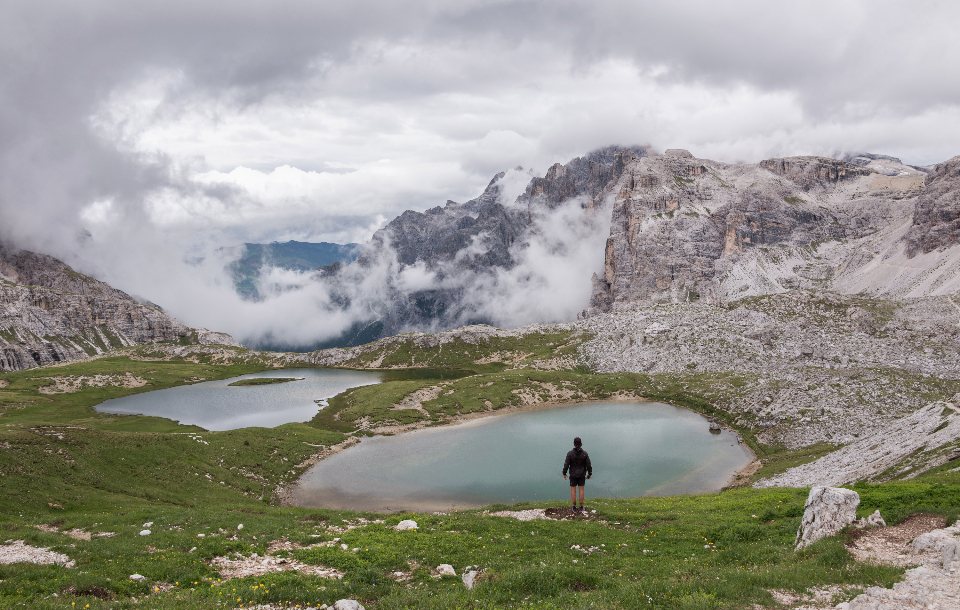
Some hut circuits are invented by walkers over decades. The Carros de Foc was invented by hut wardens over a single winter, and it shows, in the best way. In the late 1980s the people running the nine staffed refuges of the Aiguestortes i Estany de Sant Maurici National Park realised that a walker could link them all in a loop without ever leaving the mountains, and they gave the idea a name, a stamp for each hut and a loose set of rules. Nearly forty years later it has become the best known hut-to-hut route in the Spanish Pyrenees: about 55 km of trail through granite and water, with something close to 9,000 m of combined ascent and descent, walked in anything from five to nine days. Seven days is a comfortable pace.
A park made of lakes
Aiguestortes means “twisted waters” in Catalan, and the name is exact. The park, created in 1955 and enlarged since to around 14,000 hectares of core area with a wider buffer zone, sits on a granite batholith that the last ice age scraped into cirques, shelves and hollows. The result is more than 200 lakes, called estanys, strung between 1,900 m and 2,600 m, feeding streams that meander across flat meadows before dropping into the next basin. The peaks are rarely higher than 3,000 m, with Besiberri Sud at 3,030 m and the twin spires of Els Encantats at 2,747 m rising over the Sant Maurici lake as the park’s emblem. What makes the walking so good is the scale: each pass reveals a new bowl of water and rock, and the next hut is usually visible long before you reach it.
The nine huts and how they link
The circuit has no official start. Most walkers begin from Espot on the eastern side, where a track climbs to the Sant Maurici lake at 1,910 m, or from the Boi valley to the west, with its cluster of Romanesque churches. The huts sit at altitudes between about 1,900 m and 2,420 m, and the standard clockwise sequence from Sant Maurici runs Amitges, Saboredo, Colomers, Restanca, Ventosa i Calvell, Estany Llong, Colomina, Josep Maria Blanc and back down to the Mallafre hut beside the lake. Between them lie the passes: the Port de Ratera at 2,534 m, the Port de Caldes at 2,570 m, the Coll de Contraix at 2,745 m, the highest and most demanding, and the Collada de Saburo at 2,668 m. None involves technical climbing, but several cross boulder fields and one or two hold snow into early July.
Stage lengths are short by Alpine standards, typically three to six hours, which leaves afternoons for swimming in lakes that are colder than they look and for climbing the small summits above the huts. The circuit can also be cut short at several points where valleys lead out to a road.
The passport and the rules of the game
The Carros de Foc works on a simple system. Walkers buy a pass at their first hut, receive a card, and have it stamped at each refuge as they go round. Completing all nine within the season earns a small certificate and, more importantly, bragging rights. The pass usually includes a discount on hut nights and a souvenir, and it commits the holder to no particular order or schedule. Half board, with dinner, breakfast and a packed lunch, is the normal arrangement and the food is noticeably good: Catalan mountain cooking, hearty soups, stews and the occasional surprise.
A variant exists for runners, who attempt the whole loop within 24 hours in a single push. Runners stop only to stamp the card before moving on over the next pass.
Reservations and the summer season
The huts are staffed from about mid-June to the end of September, with a few opening for shorter periods in spring and at Christmas. In July and August every bed is taken most nights, so the sensible approach is to book all nine in advance through the huts’ central online system as soon as the season’s bookings open, usually early in the year. A cancelled reservation frees a bed for someone else, and a walker without a reservation may be turned away at a full hut. Late June and September are quieter, cooler and often better: fewer people on the passes, autumn colour in the larches and pines below 2,000 m, and a fair chance of a dormitory to yourselves.
Camping is not permitted inside the park except in an emergency, and the huts are the only accommodation between the valleys. That constraint shapes the whole walk and is part of what keeps the lakes so clean.
Weather, water and terrain
The Catalan Pyrenees are drier than the Basque end of the range but wetter than the Mediterranean end, and summer storms arrive most afternoons in hot spells. Plan to be over the day’s pass by early afternoon. The granite is grippy when dry and treacherous when wet, and the boulder fields on the Contraix and Saburo crossings need care with a heavy pack. Water is never far away but should be filtered or treated below the huts where cattle and sheep graze in summer. Paths are marked with cairns and painted blazes, and the circuit joins the GR11 for a few sections, but in cloud a map and the ability to read it still matter. A short list for the week:
- Boots with real ankle support for the boulder fields, plus poles for the descents.
- A warm layer and gloves: hut mornings at 2,400 m can be near freezing even in August.
- A sheet sleeping bag, a head torch and earplugs for the dormitories.
- Swimming things, because you will regret leaving them behind.
- Cash, since not every hut can take cards for small purchases.
Why it stays with you
The Carros de Foc is not the hardest walk in the Pyrenees, nor the wildest, and the huts are close enough together that a strong walker could hurry round in four days. Its charm lies elsewhere: in the rhythm of short mornings and long afternoons, in the succession of lakes that change colour with every hour, in the stamp thudding onto the card at each door. By the time a walker returns to the Sant Maurici lake with nine stamps and the Encantats catching the last light, it is clear why the wardens bothered. They had found a shape for the park that fits a week of a human life almost exactly.