
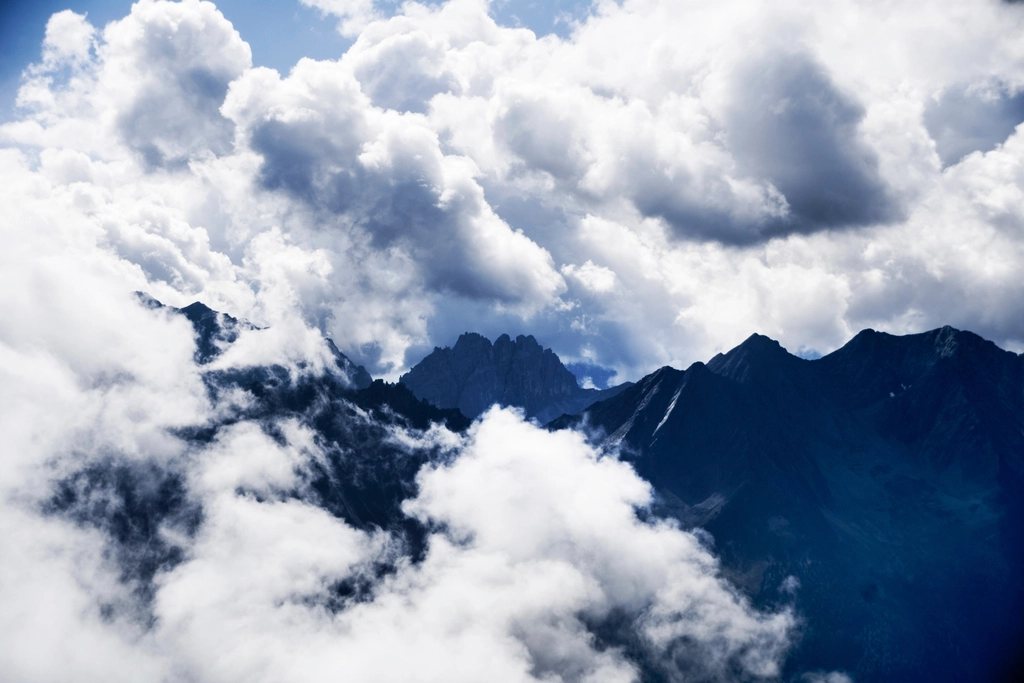
Ask any hut warden in the Alps why breakfast is served at six in the morning and you will get the same answer: because of the afternoon. Summer weather in the high mountains has a daily rhythm that is remarkably consistent from the Pyrenees to the Tatras, and once you understand it, most of the anxiety about thunderstorms disappears. You are not trying to avoid storms. You are trying to be somewhere safe when they arrive, and that turns out to be mostly a question of what time you get out of bed.
Why the afternoon is the problem
On a clear summer morning the sun heats the valley floors and the south-facing slopes. Warm air rises up the mountainsides, cools as it climbs, and its moisture condenses into the small, friendly cumulus clouds you see forming around the summits by late morning. On a stable day they stay small and drift off. On an unstable day, when the air higher up is cold, the rising air keeps going, the clouds tower into cumulonimbus, and by early or mid afternoon you have lightning, hail, a sudden drop in temperature and a downpour that can put 20 or 30 mm of rain on a slope in half an hour.
The timing is not random. The cycle needs several hours of sunshine to build, which is why storms are far more common between 14:00 and 18:00 than at any other time of day, and why the mornings are so reliably calm. The high Alpine ranges, and the Dolomites in particular, are among the most lightning-prone landscapes in Europe in July and August. In the Pyrenees the same mechanism runs, often a little later in the afternoon, and in the Tatras the storms can build quickly over the granite ridges in the same way.
The 2 pm rule
The rule is simple: be off the high ground, and ideally at the hut, by about two in the afternoon. High ground means passes, summits, ridges, exposed slabs and anything with a via ferrata cable on it. It does not mean you have to be indoors by two every day, but it means that by two you should be somewhere where a storm is an inconvenience rather than a danger: below a col, in a forest, in the hut. On the classic hut-to-hut routes this is entirely realistic. Most stages are four to seven hours of walking. Start at 07:00 and you are at the next hut for lunch, with the afternoon free to read, wash socks and watch the weather do what it does.
Wardens plan around this too. Dinner at 18:30 and lights out at 22:00 are not old-fashioned habits; they exist so that everyone can leave at dawn. A hut full of people who walked in at four in the afternoon in a storm is a hut with a worried warden.
Reading the morning sky
You do not need a meteorology course to read the day. A few signs are worth learning. Small cumulus that appear before 10:00 and grow quickly are a warning that the atmosphere is unstable; the earlier the clouds start to tower, the earlier the storms. A hazy, humid, still morning after a hot day is more dangerous than a crisp one with a breeze. Lenticular clouds, the smooth lens shapes over summits, signal strong wind aloft and a change in the weather coming. A clear night with a heavy dew and a cold dawn usually means a stable day.
The huts themselves are the best forecast on the route. Nearly every warden pins the day’s regional bulletin by the door each evening, and they will tell you, without being asked, whether tomorrow is a day to leave early or a day to leave very early. Listen to them. They have watched that particular valley for years.
What to do when it catches you
Sometimes the storm arrives at one, not four. If you hear thunder and count fewer than thirty seconds before the flash, it is close enough to matter. Get off ridges, summits and cables immediately, and move downhill if you can do so without running. Avoid isolated trees, standing in the open on a flat pasture, and sheltering in shallow caves or under overhangs, where a strike can jump across the gap. Put down your poles and anything metal a few metres away. If there is nowhere to go, crouch on your pack with your feet together, low but not lying flat, and wait; most cells pass in twenty to forty minutes. Separate a little from your companions so that one strike cannot injure everyone.
Then think about cold. A storm in July at 2,500 m can drop the temperature by 10 degrees in minutes and bring hail or wet snow, and a soaked walker in a wind is at real risk of hypothermia within an hour. This is why a waterproof jacket, a warm layer and a hat live at the top of the pack, even on a morning when the sky is blue.
Planning a route around the weather
- Put the highest pass or the ferrata section in the first half of each day, not the second.
- On a stage with two cols, ask whether there is a hut or a low point between them where you could stop.
- Build in one spare day per week. A hut day in the rain is not a failure; it is part of the plan.
- Check the regional forecast every evening and again at breakfast; mountain bulletins are usually updated before dawn.
- If the warden says leave early, leave early.
The other seasons
The 2 pm rule is a summer rule. In June there is still snow on the north-facing passes and the storms are fewer but the days can be cold and wet for long stretches. In September the air is clearer, the thunderstorms rarer, and the daily cycle softer, which is why many walkers consider it the finest month to walk between huts. But September also brings the first real snowfalls above 2,500 m and shorter days, and many huts close in the middle or at the end of the month. Whatever the season, the habit is the same: up early, over the top by noon, and at the hut with a cup of tea when the sky goes dark.